UEFA EURO Mascots from Time to Time

UEFA EURO 2012
Year: 2012
Host country: Poland and Ukraine 
Winner: Spain
The final: Spain vs. Italy
Mascot:
Slavek (Sławek) and Slavko
Once again Warner Bros. created the mascots. The twins represent two host nations, Poland and Ukraine. One twin wears Poland's national colours of red and white, the other the yellow and blue of Ukraine.
...............................................................................
UEFA EURO 2008 
Year: 2008
Host country: Austria-Switzerland
Winner: Spain
The final - 29/06/2008
Germany 0-1 Spain
Mascot:
Trix and Flix
Trix and Flix
A twin set of mascots two represent the two host countries, Austria and Switzerland. The Warner Bros. design was of two child like characters both dressed in football strips comprising solely red and white, the colours of the national flags of Austria and Switzerland.
...............................................................................
UEFA EURO 2004
Year: 2004
Host country: Portugal
Winner: Greece
The final - 04/07/2004
Portugal 0-1 Greece
Mascot:
Kinas
Kinas
A cartoon version of a boy dressed in the Portugal football strip. The mascot's name, Kinas, is taken from "Bandeira das Quinas", which is a name for Portugal's national flag.
...............................................................................
UEFA EURO 2000
Year: 2000
Host country: Belgium-Netherlands
Winner: France
The final - 02/07/2000
France 2-1 Italy
Mascot:
Benelucky
Benelucky
A lion with a devil's tail and human hands. A lion appears on the crest of the Dutch national federation, and the Belgian national team is historically nicknamed "Red Devils". The name Benelucky, is a portmanteau of "Benelux", the term for the three nations of Belgium, the Netherlands and Luxembourg, and the ending "-lucky" wishing the participating teams "good luck". It wore football boots and held a football under its left arm. One of the most striking characteristics of Benelucky was its multicoloured lions mane which incorporated the colours of both the Belgian and Dutch national flags.
...............................................................................
UEFA EURO 1996
Year: 1996
Host country: England
Winner: Germany
The final - 30/06/1996
Czech Republic 1-2 Germany
Mascot:
Goaliath
Goaliath
Goaliath was designed in a similar fashion to the original World Cup mascot from 1966 World Cup called World Cup Willie. Goliath comprised a lion, the image on the English football teams crest, dressed in an England football strip and football boots whilst holding a football under his right arm.
...............................................................................
UEFA EURO 1992
Year: 1992
Host country: Sweden
Winner: Denmark
The final - 26/06/1992
Denmark 2-0 Germany
Mascot:
Rabbit
Rabbit
The Swedish mascot was also a rabbit in the national colours with head and wristbands controlling a football like the mascot from four years previously and was called name of Rabbit.
...............................................................................
UEFA EURO 1988
Year: 1988
Host country: West Germany
Winner: Netherlands
The final - 25/06/1988
USSR 0-2 Netherlands
Mascot:
Berni
Berni
A cartoonised German Grey Rabbit with human shaped body. Berni wore an outfit in the colours of the German national flag with a black football jersey with UEFA across the front, red football shorts and yellow or golden socks additionally with white head and wristbands. Mostly depicted while jumping and controlling a football.
...............................................................................
UEFA EURO 1984
Year: 1984
Host country: France
Winner: France
The final - 27/06/1984
France 2-0 Spain
Mascot:
Peno
Péno
A white cockerel, a traditional national symbol of France, dressed in a French coloured football strip including football boots and white gloves.
...............................................................................
UEFA EURO 1980
Year: 1980
Host country: Italy
Winner: West Germany
The final - 22/06/1980
Belgium 1-2 West Germany
Mascot:
Pinocchio
Pinocchio
Based on the character from the children's story of the same name. Pinocchio comprised a small wooden boy with long nose in the colours of the Italian national flag and a white hat emblazened with EUROPA 80 (http://www.wikipedia.org/)
...............................................................................

Cooperative Principles: The Hedging of Maxims


Hedging is any deliberately ambiguous statement or any equivocal statement. Grundy (2000) includes hedging among other mitigating devices in his politeness marker category ‘downgraders’. He calls there devices, hedges, play-downs, understaters, downtoner, or ‘minus’ comminters.

The hedges and intensifiers are more comment on the extent to which the speakers abiding by the maxims which guide our conversational contributions than a part of what is said or conveyed. It seems that when we talk, we not only convey messages, but also frequently like to tell each other how informative, well founded, relevant, and perspicuous these messages are. Speakers frequently use highly grammaticalized hedges and intensifiers to inform their addressees of the extent to which they are abiding by the maxims. These hedges and intensifiers show that the guiding principles for talk suggested by Grice really do exist and that speakers orient reflexively to these principles as they communicate.

Levinson (1985) states that the theory of conversational implicature is a theory of language in which language is viewed as a self-contained system of rules. He further argues that there are interesting relations between structure and function of the language. Thus, the English particles such as ‘well’, ‘oh’, ‘ah’ ‘so’, ‘anyway’, ‘actually’, ‘still’, ‘after all’, are the lexical items which at time refer to the notion of conversational implicature and are being described as “maxim hedges” indication how an utterance is preface in order o make up to cooperative expectation.

Moreover, in academic speech, hedging is most appropriately described as either (a) a lack of competence commitment to the truth value of an accompanying proposition, or (b) a desire not to express that commitment categorically.

Myers (1989) groups all linguistic devices under his categories of "negative politeness and hedging, focusing less on the description of the linguistic devices themselves than on their purpose or motivation. Further, hedging is a politeness strategy when it marks a claim or any other statement as being provisional, pending acceptance in the literature, acceptance by the community-in other words, acceptance by the listeners.  He goes to point out that hedging can be realized in any different linguistics forms, and gives examples of the use of condition statements, modifiers, verb choice, framing statement that indicates the weight a statement should have or the degree of doubt involved, and even statements of personal opinion.

Quality Hedges
Brown and Levinson (1990) state that quality hedges may suggest that the speaker is not taking full responsibilities for the truth of his utterances. For instance:
          think…
I         believe…
          assume…

Or alternatively they may stress S’s commitment to the truth of his utterances; in other words, they reflect the commitment of the writer to the quality of the proposition contained in the subsequent part of the statements and do not contribute truth value to the statements as a whole. Such as, I absolutely (deny/ promise/believe) that…, others take the opposite view and say…, The issue says…, It is quite right what people say…, Some people believe that…, So you can imagine even…, In this case..., etc. Or they may disclaim the assumption that the point of S’s assertion is to inform H, such as, As you know…, As it well known…, As you and I both know…, etc.

Quantity Hedges
Quantity hedges, we find archetypal examples in these English expressions, which give notice that not as much or not as precise information is provided as might be expected, such as: roughly, more or less, approximately, give or take a few, or so, I should think, I can’t tell you more than that it’s…, to some extent, all in all, in short, basically, so to speak, etc. the assertion of personal opinion show that the information tried to be conveyed is limited.

Relevance Hedges
In Relevance hedges, we note that because of sensitivity of topic changes as impositions on H’s face, such changes are often done off record. Hedges that mark the change, and perhaps partially apologize for it, include, by the way…, oh I know…, anyway…, this may not be relevant/ appropriate/ timely but…, I might mention at this point…, while I remember…, etc.

Manner Hedges
Finally, some common Manner hedges includes, what I meant was…, more clearly…, to put it more simply…, you see, yeah?, got it?, OK?, is that clear?, see?, etc.

..............................................................................
See also:
Grice's cooperative principle 
Cooperative Principle: Implicature
Cooperative Principle: Flouting Maxims
The Hedging of Maxims 

World Tallest Tower: Tokyo Skytree

Tokyo Skytree_1

In the class of tower, Tokyo Skytree is considered as the tallest tower on earth, it has 634 meters  tall (2,080 feet), twice as tall as the Eiffel Tower, it is considered as the world's second-highest building after Dubai's Burj Khalifa which has 829.84 meters tall (2,722.57 feet), and it becomes the tallest structure in Japan in 2010 and the tallest tower in the world, displacing the Canton Tower (Guangzhou TV Tower), 450 meters (1,480 feet)  in March 2011.

Tokyo Skytree is located at Sumida, Tokyo, Japan which  is now open to the world to visit after almost 4 years of construction with 580000 workers costing a total of roughly 65 billion yen for the tower alone.

The construction of the tower actually finished on the 29th of February earlier this year after a two month delay due to the earthquake but it’s today on the 22nd of May that they have actually allowed people to enter.

Moreover, the main attractions are the two observation platforms at 350 meters (1,148 feet) and 450 meters (1,476 feet) as well as the restaurant with the best view of Tokyo, in fact, even better than Tokyo Tower which is only 333 meters (1,093 feet) and only served as an observation tower to the public.

Bayern München and Allianz Arena

FC Bayern Munchen


This Sunday (20/05/12) there will be a final match waited by all football lovers in this surface of the earth, yes it is the final battle of Champion League between Bayern München  vs. Chelsea in which in the quarter final succeeded to eliminate their rivals.  Bayern München  forced Real Madrid to surrender through penalty kick battle and Chelsea won from Barcelona.

Since its founding,  Bayern München has four times to feel the glory of lifting the trophy of Champion League, 1974, 1975, 1976, 2001, I wish it becomes five this year, and four times also as runner-up, 1982, 1987, 1999, 2010. In domestic,  It is best known for its professional football team, which plays in the Bundesliga, the top league of German football and is the most successful football club in Germany, having won 22 national titles and 15 cups.

Previously, the "home" of Bayern used to be Munich Olympic Stadium sharing with TSV 1860 München since 1972 and have played their home games at the Allianz Arena since the start of the 2005–06 season.

Moreover, Allianz Arena which becomes the "home" of Die Roten, the nickname of FC Bayern München,  and TSV 1860 München is one of the most spectacular stadiums in the world. The Allianz Arena is a football stadium in the north of Munich, Bavaria, Germany. It is the third biggest stadium in Germany after Signal Iduna Park in Dortmund and the Olympiastadion in Berlin. The capacity of this arena is able to accommodate 69,901 spectators. You can imagine how big it is. What makes this stadium so unique is that the façade is made from 2760 ETFE-foil cushions which are continuously inflated with dried air. Each cushion has its own illumination that can change from red to blue or white. When FC Bayern has a home match, the Arena is illuminated all in red, for the home matches of TSV 1860 all lights are blue, and for neutral matches the colour is white. If for instance the German national team is playing, the stadium will be illuminated all in white.


Five Definitions of Deep Structure

1. Deep structure is the output of phrase structure rules
   We can not have deep structure if we don’t have phrase structure rules.
e.g.
tree diagram


2. Deep structure is the input of transformation rules. We can apply transformation rules if we have deep   structure.
transformation rules


3. Deep structure is the level of grammar which can explain adequately the concepts of subject, direct object and indirect object.
  • Subject is a noun phrase which is directly dominated by category of sentence.
  • Direct object is a noun phrase which is directly dominated by verb phrase
  • Indirect object is a noun phrase which is directly dominated by prepositional phrase.
e.g.

4. Deep structure is the level where we can apply selectional restriction rules (rules that restrict the selection of lexicons in a sentence)

e.g. the grass devoured the elephant (it is impossible, how the grass can eat an elephant)
The rule is:
- animate + animate > subject
+ animate +animate < subject

e.g. The tiger devoured the goat. 
The ones who don’t follow the selectional restriction rules are the linguist, writers, author.

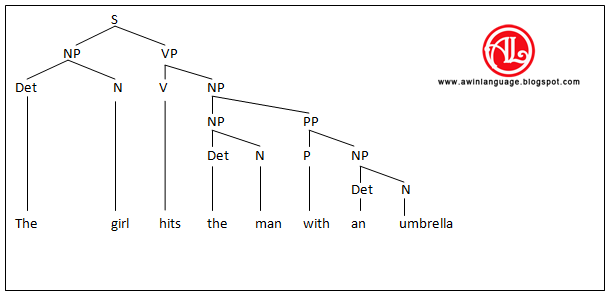
5. Deep structure is the level which can solve the problem of ambiguity.
e.g.
"The girl hits the man with an umbrella."

Tree diagram
Note:

  • The meaning: the girl hits the man who brings an umbrella;
  • The PP is directly dominated by NP.

Note:
  • The meaning: the girl hits the man by using an umbrella;
  • The PP is directly dominated by VP.

How to Make Menu and Sub-menu Tab

How to make menu and sub menu tab without jQuery? If you are interested in making menu and sub menu tab just like menu bar of this blog, or see demo, just do these following steps:
  • Go to your dashboard => Template => choose Edit HTML => select proceed => check expand widget templates (above right side);
  • Find this below  inside the box code (if you face difficulty in finding it just press F3 if your browser is Chrome or Ctrl+F for Firefox, and copy paste one of below codes, press enter); 

  • Copy and paste these below code right before the above code;


Note:
#cat-nav {background:#000;margin:0 1px;padding:0;height:35px;} change the 000 with any kinds of color you desire for the background color.
#cat-nav li:hover { background:#787876; } color when menu or sub menu is pointed
TITLE change with title whatever you want
#YOUR LINK# change with link whatever you want (page, posting, or label link, etc)

  • That's it, save and enjoy;

  • If you've done it correctly, it will appear menu bar like this above look in your header.
Like us on Facebook
Follow us on Twitter
Recommend us on Google Plus